Marriage is an important life decision, and many families in India traditionally consider Kundli Milan before finalizing a marriage. Also known as Kundli Matching, Guna Milan, or Ashtakoota Milan, this Vedic astrology practice compares the birth charts of two individuals to assess different areas of compatibility.
Kundli Milan traditionally uses eight compatibility factors, known as Ashtakoota, with a maximum score of 36 Gunas. The system primarily considers the Moon sign and birth Nakshatra of both individuals.
However, the total Guna score should not be treated as the only factor in deciding whether two people are suitable for marriage. A detailed horoscope analysis can also consider planetary positions, marriage houses, Dashas, and specific Doshas.
Kundli Milan is the traditional Vedic astrology method of comparing the birth charts of two prospective partners before marriage.

The purpose is to understand areas such as:
The most commonly used method is Ashtakoota Guna Milan, which evaluates eight different Kootas and assigns a maximum of 36 points.
Kundli matching is traditionally used to gain additional insight into the compatibility of two individuals before marriage. It can help identify areas that may require greater understanding and communication between partners.
Some of the commonly explored areas include:
Kundli Milan should be viewed as a traditional astrological guidance tool rather than a guarantee of marital success. A healthy marriage also depends on communication, trust, respect, shared values, financial understanding, and mutual consent.
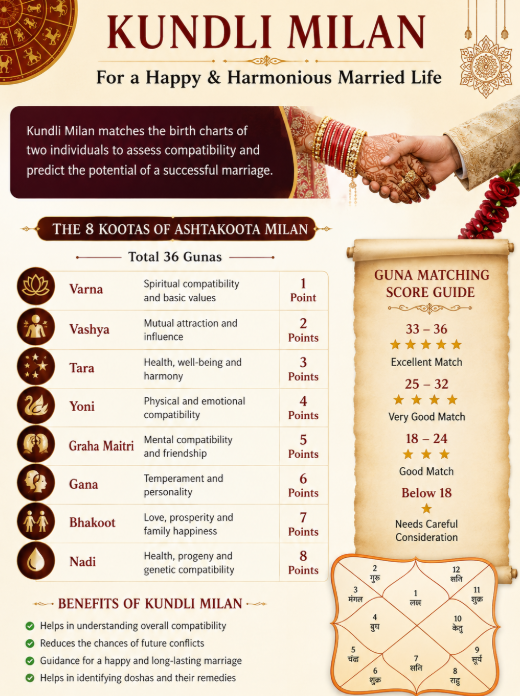
The 36 Gunas are divided into eight Kootas. Each Koota carries a different number of points.
| Koota | Maximum Points | What It Traditionally Indicates |
| Varna | 1 | Basic values and spiritual compatibility |
| Vashya | 2 | Mutual influence and relationship dynamics |
| Tara | 3 | Well-being and compatibility of birth stars |
| Yoni | 4 | Physical and intimate compatibility |
| Graha Maitri | 5 | Mental connection and friendship |
| Gana | 6 | Temperament and personality |
| Bhakoot | 7 | Emotional and family compatibility |
| Nadi | 8 | Traditional health and progeny-related compatibility |
Together, these eight Kootas make up 36 Gunas.
Varna Koota carries one point and traditionally represents basic values, outlook, and spiritual compatibility between the partners.
Although it has the lowest weight in the Ashtakoota system, it forms part of the overall compatibility assessment.
Vashya Koota carries two points. It is traditionally associated with attraction, mutual influence, and interpersonal dynamics.
It can help astrologers understand how naturally two individuals may interact and respond to one another.
Tara Koota carries three points and is calculated using the Nakshatras of the two individuals.
Traditionally, it is associated with well-being, compatibility, and the general harmony between the birth stars.
Yoni Koota carries four points and is traditionally used to examine physical attraction and intimate compatibility.
For marriage matching, this aspect can provide additional insight into how comfortably the partners may relate to each other on a personal level.
Graha Maitri carries five points and focuses on mental compatibility, friendship, communication, and mutual understanding.
A strong Graha Maitri score is traditionally considered supportive of emotional connection and companionship.
Gana Koota carries six points and relates to temperament and personality.
It is commonly divided into three categories:
Astrologers traditionally compare the Gana of both partners to understand potential differences in temperament.
Bhakoot carries seven points and is one of the more heavily weighted Kootas.
It is traditionally associated with emotional compatibility, family harmony, relationship stability, and certain aspects of the couple's future together.
A detailed analysis may be required when a Bhakoot-related concern appears rather than relying only on the numerical score.
Nadi carries the highest weight of eight points.
Traditionally, Nadi matching is associated with health, biological compatibility, and progeny-related considerations. Nadi-related concerns are often examined carefully during marriage matching.
Traditionally, 18 out of 36 Gunas is often considered the minimum acceptable score in Ashtakoota matching. Scores above this threshold are generally interpreted as indicating greater compatibility, although the exact interpretation can vary according to the broader horoscope analysis.
A commonly used broad interpretation is:
However, a higher score does not automatically guarantee a successful marriage.
For example, a couple with a high Guna score may still require further examination if significant Doshas or challenging planetary combinations appear in their individual birth charts.
Similarly, a comparatively lower score does not necessarily mean that marriage is impossible. Experienced astrologers may examine the complete Kundli before reaching a conclusion.
No. Kundli Milan should ideally be considered one part of a broader compatibility assessment.
A detailed Vedic astrology consultation may examine:
This broader approach can provide more context than simply looking at the final 36-Guna score. Traditional astrology sources also emphasize that overall chart analysis can complement Guna Milan.
Manglik Dosha, also called Mangal Dosha, is another factor that may be considered during marriage horoscope matching.
It is traditionally assessed based on the placement of Mars in specific houses of the birth chart.
When Manglik Dosha is identified, astrologers may compare the charts of both individuals and examine whether there are traditional cancellation or balancing factors.
Therefore, simply seeing "Manglik" on a Kundli report should not automatically be treated as a final verdict. A complete chart assessment is important.
For an accurate horoscope matching analysis, the astrologer generally requires:
Accurate birth information is important because the planetary positions, Moon sign, Nakshatra, Ascendant, and other chart factors depend on birth details.
Today, couples can access Kundli matching services online without visiting an astrology center.
Online matching can offer:
With online astrology services, couples can get their Kundli matching analysis without visiting an astrologer's office physically.
Online Kundli Milan can be useful for couples and families who want:
An online consultation can also be particularly convenient when the prospective partners live in different cities or countries.
Kundli matching is not limited to arranged marriages.
Couples in a relationship can also use Kundli Milan for love marriage to explore traditional astrological compatibility before making long-term decisions.
For love marriages, a broader consultation may examine emotional compatibility, communication patterns, marriage timing, family-related factors, and the overall strength of the marriage indicators in both charts.
In arranged marriages, Kundli Milan can be used as one of several traditional compatibility checks.
Families may compare the prospective bride's and groom's birth charts before proceeding with engagement or marriage discussions.
However, astrology should complement—not replace—important real-world conversations about values, finances, career plans, family expectations, communication, and personal consent.
Kundli Milan can provide a structured traditional approach to understanding compatibility between two prospective partners. The 36-Guna score is useful as a starting point, but it should not be the only consideration.
A deeper analysis of both birth charts can provide additional context about compatibility, Doshas, planetary influences, marriage timing, and other relationship-related factors.
If you are planning marriage and want to understand your compatibility through Vedic astrology, GrahVedant offers online astrology and Kundli analysis services designed to help individuals explore their birth charts with personalized guidance.
Use Kundli Milan as a tool for reflection and traditional guidance, while also considering mutual understanding, communication, shared values, consent, and practical compatibility when making important relationship decisions.
What is Kundli Milan?
Kundli Milan is a traditional Vedic astrology practice that compares the birth charts of two prospective marriage partners to assess compatibility.
How many Gunas are there in Kundli Milan?
There are 36 maximum Gunas in the traditional Ashtakoota system, divided across eight Kootas.
Is 18 Guna considered good for marriage?
Traditionally, 18 out of 36 is used as a basic compatibility threshold. However, the complete Kundli should be analyzed before making a marriage decision.
Is 24 Guna a good match?
A score of 24/36 is generally considered acceptable to good in traditional Guna Milan interpretations. The individual Koota scores and the complete birth charts should also be examined.
Can marriage happen if Kundli matching is below 18?
A lower Guna score does not by itself provide a complete answer. A detailed horoscope analysis can examine the specific reasons for the lower score and other supportive or challenging planetary combinations.
What is Nadi Dosha?
Nadi Dosha is a traditional consideration in Ashtakoota matching that arises from certain Nadi combinations between prospective partners. Its significance should be assessed in the context of the complete Kundli rather than through the score alone.
Can Kundli Milan be done online?
Yes. Online Kundli matching services can compare the birth details of two individuals and provide a traditional compatibility analysis.