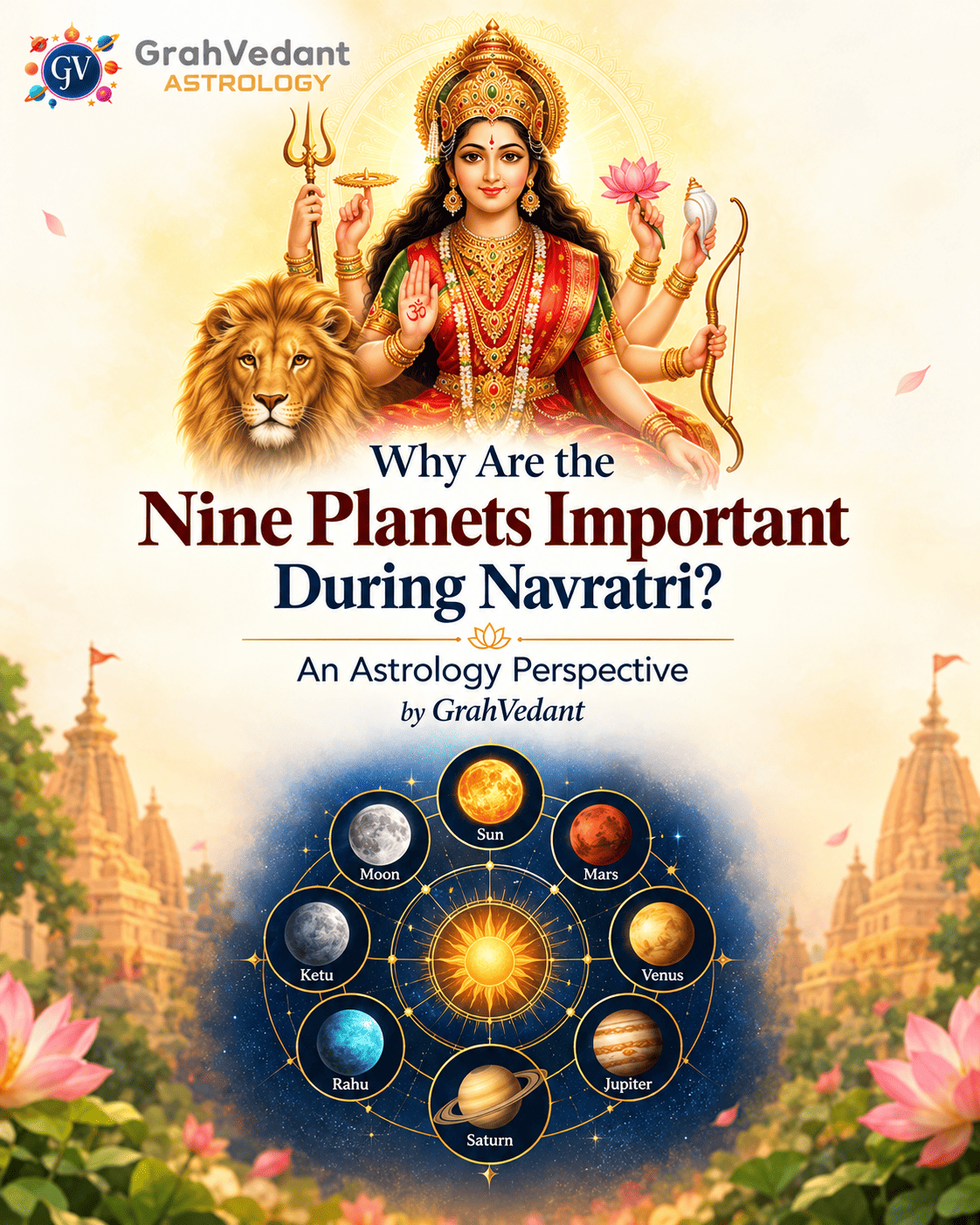
Navratri celebrates nine forms of Goddess Durga, collectively known as Navadurga. Vedic astrology recognises nine Navagraha, comprising seven traditional planetary bodies and the lunar nodes Rahu and Ketu.
One commonly discussed interpretation connects Shailputri with the Moon, Brahmacharini with Mars, Chandraghanta with Venus, Kushmanda with the Sun, Skandamata with Mercury, Katyayani with Jupiter, Kalaratri with Saturn, Mahagauri with Rahu, and Siddhidatri with Ketu.
Religious practices such as prayer, mantra chanting, meditation, fasting, and charity are part of traditional Navratri observances. However, they should not be presented as guaranteed ways to change planetary placements or produce specific life outcomes.
Kundali Analysis traditionally examines the complete birth chart, including planetary positions, houses, signs, aspects, Nakshatras, dashas, and transits. This provides a broader framework than interpreting one planet or zodiac sign in isolation.
GrahVedant provides astrology-related consultation services, including Kundali Analysis, Vedic Astrology, and Numerology. People in Bhubaneswar, Berhampur, and elsewhere in Odisha can visit grahvedant to learn more about available services.
Navratri is an opportunity to combine devotion with self-reflection and a deeper appreciation of traditional astrological symbolism.
Navratri is a festival of devotion, spiritual reflection, and the worship of Goddess Durga in her nine divine forms. Along with prayers, fasting, and traditional celebrations, Navratri also offers an opportunity to explore the relationship between spirituality and Vedic astrology.
Have you ever wondered what connects the nine forms of Goddess Durga with the nine planets of Vedic astrology?
Known as Navadurga and Navagraha, these two concepts hold an important place in Hindu religious traditions and astrological interpretations.
For people interested in Vedic Astrology in Odisha, understanding the symbolism of Navratri and the nine planets can provide an interesting perspective on personal growth, discipline, relationships, and spiritual awareness.
At GrahVedant, we believe that exploring traditional astrological concepts can encourage self-reflection and a deeper understanding of your birth chart.
Navratri means nine nights dedicated to the worship of Shakti, the divine feminine power. During this festival, devotees worship nine forms of Goddess Durga: Maa Shailputri, Maa Brahmacharini, Maa Chandraghanta, Maa Kushmanda, Maa Skandamata, Maa Katyayani, Maa Kalaratri, Maa Mahagauri, and Maa Siddhidatri.
In Vedic astrology, the Navagraha consist of the Sun, Moon, Mars, Mercury, Jupiter, Venus, Saturn, Rahu, and Ketu. These celestial bodies are traditionally interpreted in relation to different aspects of human experience.
Some contemporary astrological interpretations associate each form of Navadurga with a particular planetary influence. These associations differ across traditions and should not be considered a universally prescribed religious rule.
The deeper significance lies in understanding the qualities represented by the Goddess and the planets, including courage, wisdom, emotional balance, confidence, patience, and spiritual awareness.
The following associations represent one commonly discussed contemporary astrological interpretation.
Maa Shailputri is worshipped on the first day of Navratri. She symbolises strength, stability, and grounding.
In Vedic astrology, the Moon, known as Chandra, is traditionally associated with the mind, emotions, sensitivity, and mental peace.
This connection encourages reflection on emotional balance and the way we respond to everyday situations. Rather than reacting immediately to challenges, developing patience and awareness can help us make thoughtful decisions.
The second day of Navratri honours Maa Brahmacharini, who represents discipline, devotion, determination, and perseverance.
Mars, or Mangal, is associated with courage, initiative, energy, and action in Vedic astrology.
Their symbolic connection reminds us that courage is not always about being aggressive. Sometimes it means remaining committed to a goal, continuing to learn, and working patiently through professional or personal challenges.
Maa Chandraghanta is associated with courage, grace, and protection. Some modern astrological interpretations connect her with Venus, known as Shukra.
Venus traditionally represents relationships, harmony, beauty, comforts, and artistic expression.
This association encourages us to reflect on how we maintain relationships with family members, colleagues, and loved ones. Healthy communication, mutual respect, and emotional understanding can be important parts of creating harmony in everyday life.
Maa Kushmanda is the fourth form of Navadurga and is associated with light, radiance, and cosmic creation.
In Vedic astrology, the Sun, or Surya, symbolises confidence, identity, vitality, authority, and leadership.
The connection offers an opportunity to reflect on personal confidence and responsibility. Are you recognising your abilities? Are you making decisions thoughtfully? Are you taking responsibility for your goals?
These questions can help turn the festival into a meaningful period of self-reflection.
The fifth day is dedicated to Maa Skandamata, who represents maternal care and nurturing energy.
Mercury, known as Budha, is traditionally associated with communication, intelligence, reasoning, and learning.
This combination highlights the importance of thoughtful communication and continuous learning. Students, professionals, and business owners can use this symbolism as a reminder to improve their planning, listen carefully, and express their ideas clearly.
Maa Katyayani is the sixth form of Goddess Durga and is associated with strength and determination.
Some contemporary astrological interpretations connect her with Jupiter, or Guru, traditionally associated with wisdom, knowledge, guidance, and growth.
The symbolism encourages us to consider the long-term consequences of our choices. Decisions involving education, marriage, career, and business require more than immediate enthusiasm; they also benefit from patience, knowledge, and practical judgement.
Maa Kalaratri is known for her powerful form and association with the removal of fear and darkness.
Saturn, or Shani, represents discipline, responsibility, patience, perseverance, and accountability in traditional Vedic astrology.
Saturn is not simply a symbol of difficulty or misfortune. Its traditional interpretation also emphasises consistent effort and responsibility.
This association reminds us that progress often requires time, dedication, and the willingness to learn from experience.
Maa Mahagauri symbolises purity, peace, and clarity. In some contemporary interpretations, she is associated with Rahu.
Rahu is traditionally connected with ambition, desires, unconventional interests, and intense worldly pursuits.
This symbolic relationship encourages reflection on whether our ambitions genuinely support our goals or arise mainly from comparison and external pressure.
Understanding our priorities can help us pursue growth without losing sight of balance and personal values.
Maa Siddhidatri is the ninth form of Navadurga and represents spiritual fulfilment and divine wisdom.
Ketu is traditionally associated with detachment, introspection, spirituality, and liberation.
This connection reminds us that personal growth is not always about gaining something new. Sometimes it involves letting go of unnecessary expectations, developing self-awareness, and learning to appreciate what truly matters.
The Navagraha are important elements of traditional horoscope interpretation. Each graha has its own symbolism, but an individual's birth chart is generally studied as a complete system.
A traditional Kundali Analysis may consider:
This is why interpreting a person's life using only their zodiac sign or a single planetary placement can provide an incomplete picture within the traditional astrological framework.
People exploring Kundali Analysis in Bhubaneswar or Berhampur may wish to understand how astrologers examine these factors together when discussing specific questions about career, relationships, marriage, or personal development.
This is a common question among people interested in Navratri astrology.
Traditional devotional practices include mantra chanting, prayer, meditation, fasting, charity, lighting a diya, reading sacred texts, and participating in temple rituals. Practices vary according to family customs, regional traditions, and personal beliefs.
However, a religious practice should not be presented as a guaranteed way to change a planetary position or achieve a particular outcome.
When exploring traditional planetary remedies, an astrologer may first examine the relevant birth-chart factors and the concern being discussed. Remedies should be approached thoughtfully rather than chosen because of alarming online predictions.
There is no single remedy that is suitable for everyone simply because they share the same zodiac sign.
People in Bhubaneswar, Berhampur, and other parts of Odisha may explore Vedic astrology to learn about traditional horoscope interpretation and its symbolic approach to important life questions.
GrahVedant offers astrology-related services, including personalized Kundali Analysis, Vedic Astrology Consultation, Numerology, Horoscope Reading, and other spiritual guidance services.
Whether you are curious about your birth chart or want to discuss traditional astrological perspectives on career, marriage, relationships, or personal goals, a personalized consultation can focus on your individual questions rather than general zodiac predictions.
Explore the services available at GrahVedant.
Navratri celebrates the nine forms of Goddess Durga, while Vedic astrology recognises nine Navagraha. Some contemporary astrological interpretations connect each form of Navadurga with a planetary influence, although these associations vary between traditions.
In one commonly discussed astrological interpretation, Maa Kushmanda is associated with the Sun, which traditionally symbolises confidence, vitality, identity, and leadership.
Navratri rituals are devotional and spiritual practices. Although traditional astrology includes remedies intended to address planetary concerns, there is no scientific guarantee that such practices change planetary positions or produce specific results.
Kundali Analysis examines birth-chart factors such as planetary placements, houses, signs, Nakshatras, and dashas. In traditional practice, these elements are considered together rather than interpreting an individual's future from just one planet.
GrahVedant offers astrology-related consultation services, including Kundali Analysis and Vedic Astrology. Visit grahvedant.com for information about available services.
Navratri offers nine days of devotion, but its symbolism can also inspire reflection on courage, emotional balance, wisdom, discipline, harmony, and spiritual awareness.
The connection between Navadurga and Navagraha provides one traditional way to explore these themes. While planetary associations differ across astrological traditions, the festival remains an opportunity to strengthen personal discipline, reflect on important decisions, and appreciate the spiritual significance of the nine forms of Devi.
At GrahVedant, the exploration of Vedic Astrology and Kundali Analysis begins with understanding the individual birth chart and the questions that matter to each person.
Nine nights of devotion. Nine forms of Shakti. Nine planetary symbols. One opportunity to look within.